
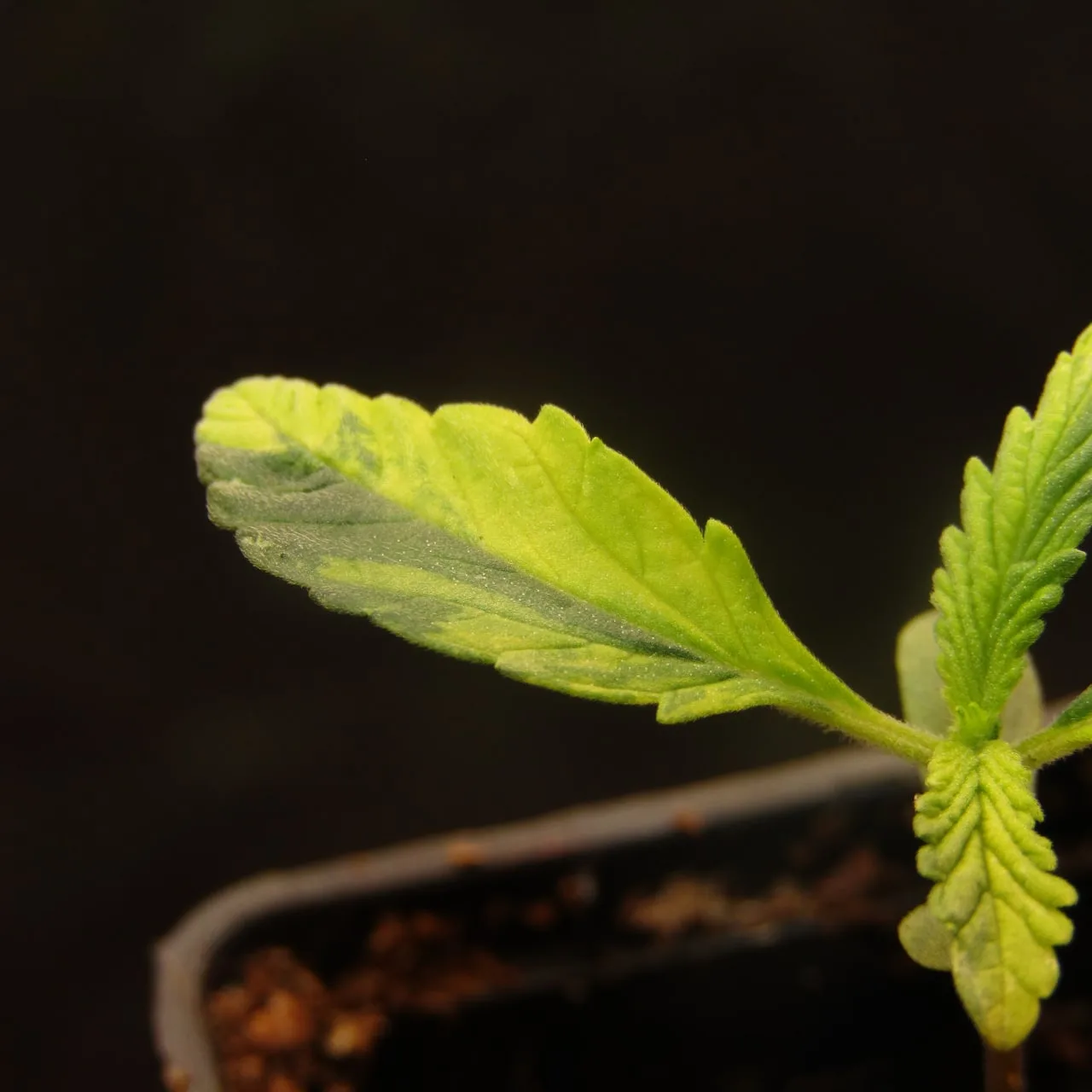
Hey, bro! Some mutants have a normal leaf shape and normal branching, and only the color changes. A green half of a leaf sits beside a cream-colored one, yellow stripes run across the blade, and the next leaf is colored differently again. This patchwork of color is called variegation.
Freakshow has a specific project and a person behind it. Variegation is the name of a visible trait, and it occurs in many plants. The same pattern comes from different changes, and variegated plants do not share a single pedigree.
Variegation still has a history, and it reaches far beyond cannabis: to the earliest studies of inheritance outside the cell nucleus, to chimeric plants, and to Spain’s Divina with its detailed documentary trail.
Where the color comes from
A variegated leaf has areas of different colors. In cannabis, that means ordinary green tissue next to yellow, cream-colored, or almost white tissue. In the pale sectors, chloroplast formation or the accumulation of photosynthetic pigments is disrupted.
Chlorophyll is found in chloroplasts, small structures inside the plant cell where photosynthesis takes place. When their development is disrupted, the tissue changes in both color and function. The white part of a leaf can still be alive: in studied variegated mutants, it contained living cells with poorly developed plastids lacking their normal color. VAR2 study, 2000
Variegation is a descriptive term: it names the pattern on a leaf and says nothing about its genetic cause.
Purple coloration does not belong here. Reddish and violet shades in cannabis come from anthocyanins, and they do not make the tissue chlorophyll-free. Botanical description of Cannabis sativa, CFIA
1909: Correns and Baur
In 1909, Carl Correns and Erwin Baur published studies on the inheritance of variegation. Both worked with variegated plants, but of different species.
Correns worked with Mirabilis, the garden four-o’clock. In his experiments, coloration was inherited through the maternal line. Baur took Pelargonium and saw that the trait was passed on by both parents. He linked this to plastids. These studies started the concept of inheritance outside the nucleus. Historical account of Correns’s and Baur’s work
Genetics was only taking shape at the time. The model of equal contributions from both parents did not work for variegated leaves, and they revealed a separate system of inheritance.
The phenomenon itself existed long before Correns and Baur, and there was no cannabis in their experiments. They explained the mechanism, and that changed how botanists saw inheritance in plants.
Chimeras
Variegation is often explained like this: “The white half is one genotype, the green half another.” For some variegated plants, that is exactly the case.
A patch of altered cells appears in a plant. Their descendants form part of a shoot, a leaf, or an entire tissue layer. The plant remains a single organism, but its cell lineages differ. Such a plant is called a chimera, an ordinary botanical term.
A chimera is not the only possibility. In some variegated plants, the cells of the green and pale sectors carry the same mutant genotype, and only plastid development in those cells differs. So a sharp color boundary does not show where the change in DNA lies. Chen and colleagues, VAR2
Two almost identical leaves can have different genetic histories. In one case, different cell lineages sit side by side; in the other, a single change shared by the whole plant shows up unevenly in its cells.
Specific genes
By the end of the twentieth century, molecular biology had taken up variegation. One example is Arabidopsis thaliana, a small plant used to study general mechanisms of development.
In 2000, two research groups linked the VAR2 trait to a protein of the FtsH family that works in chloroplasts. One paper was published by Meng Chen and colleagues, the other by K. Takechi, Wataru Sakamoto, and coauthors. Variegation could now be described at the level of a specific gene and protein. Chen and colleagues, Takechi and colleagues
After these papers, the same variegation came to be seen as different processes: plastid formation, the work of plastid proteins, and the interaction between the cell nucleus and the organelles.
VAR2 is an Arabidopsis gene. The molecular cause of variegation in cannabis is investigated in cannabis itself.
The variegated Blueberry at KalySeeds
Variegation appears in KalySeeds history before Divina. A retrospective description dates the beginning of the program that later produced SWAG to 1990–1995. The starting plant was a variegated mutant Blueberry The first generation from a cross between two parents. F1 ↗ male. The text mentions both unusual coloration and changes to the leaves. KalySeeds description preserved by SeedFinder
This is a retrospective: the author described the program later, in a catalog.
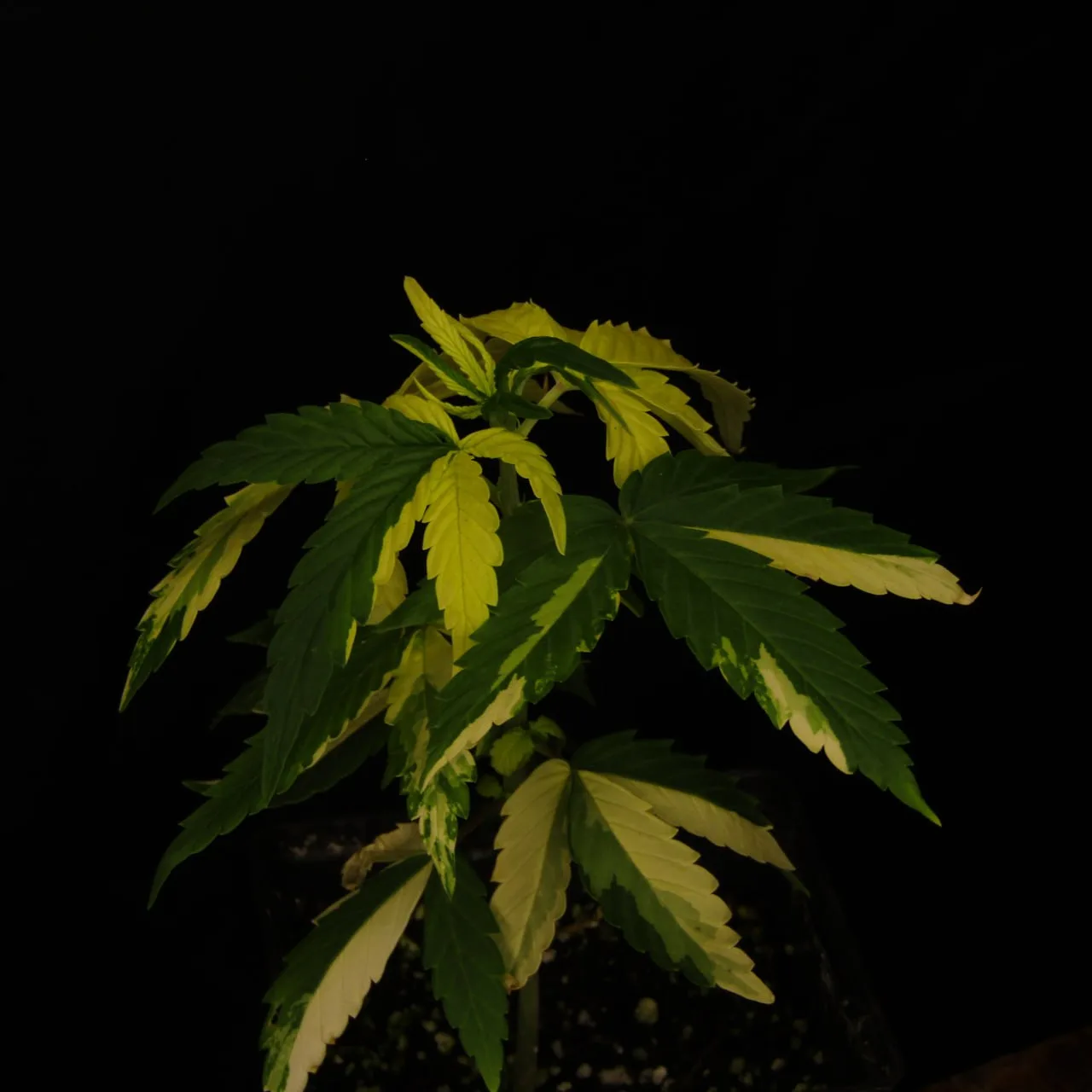
Variegated plants were part of this program from the very beginning. In Divina, variegation arose separately, as a spontaneous shoot on Pilar.
Divina from Spain
Divina’s documented history is more detailed. The Phytoplant Research patent description gives the date as May 25, 2015: a spontaneously altered shoot with variegated foliage was discovered on a Pilar plant. A locally altered branch like this is called a bud sport. The document names Salvatore Casano as the inventor.
The new line was named Divina, and the application also mentions an earlier proposed name, Enza. It describes yellow-and-green coloration and reduced chlorophyll content.
According to the document, Divina received EU plant variety protection on July 16, 2018, under decision EU 50045. The US application was filed on November 28, 2018, published on May 28, 2020, and patent USPP33483 was granted on September 14, 2021. Divina’s patent history
These dates apply only to Divina, and the patent names Casano as the creator of this particular line.
Pilar and Divina by markers
In 2019, Salvatore Casano published a paper in Acta Horticulturae based on the IHC2018 congress proceedings. In it, Pilar and Divina matched across the entire panel of 15 SSR markers used. In the F1 offspring described, the foliage was green. Casano’s paper
A marker panel checks a few selected regions of the genome. Across these 15 regions, variegated Divina cannot be told apart from the original Pilar.
For Divina, there is a description of the discovery, photographs, and measurements.
Yellow tissue under the microscope
In the same paper, Casano examined the yellow parts of Divina’s stems, leaves, and bracts and found different types of glandular trichomes on them. The tissue lost its green color, but the trichomes on it remained. Casano, 2019
Pigments determine the color of a tissue, while trichomes are separate structures on its surface. That is why a pale area can keep a complex structure.
Divina made it into the proceedings of an international horticultural congress. There, cannabis was examined through an ornamental trait and through differences between tissues.
Variegation and disease
Spots and mosaic patterns also occur with disease. A study of field-grown hemp from Oregon described chlorotic mosaic and deformations among the symptoms, and the presence of pathogens was investigated separately. Rivedal and colleagues, 2023–2024
A leaf pattern cannot tell a mutation from a disease. The altered coloration is described first, and its genetic nature, inheritance, or connection to disease is checked afterwards.
The pedigree of a variegated line is reconstructed from records: who found the plant, when, and from which parents. For Divina, this information is in the patent.
Common questions
Who first found variegated cannabis?
An early case is the variegated Blueberry F1 male in the KalySeeds program, which the author dates to 1990–1995. Divina is the most thoroughly documented: the altered shoot on Pilar was found in 2015.
Is variegation always inherited in the same way?
No. In Correns’s experiments with Mirabilis, coloration followed the maternal line; in Baur’s experiments with Pelargonium, it came from both parents; in Arabidopsis, variegation is caused by mutations in the VAR2 gene.
Is every half-white leaf a chimera?
No. Variegated tissue also occurs when the whole plant carries the same mutant genotype. Only investigation shows whether it is a chimera.
Is Divina the first variegated cannabis?
No. The patent describes the history of one line, and KalySeeds already had a variegated Blueberry F1 male in 1990–1995, according to the author’s account.
The bottom line
Variegation has several separate histories: Correns’s and Baur’s experiments in 1909, molecular work on plastids, collectors’ accounts, and the Pilar shoot of 2015.
What connects them is the visible variegation. Each case has its own origin, mechanism, and history of observation.