
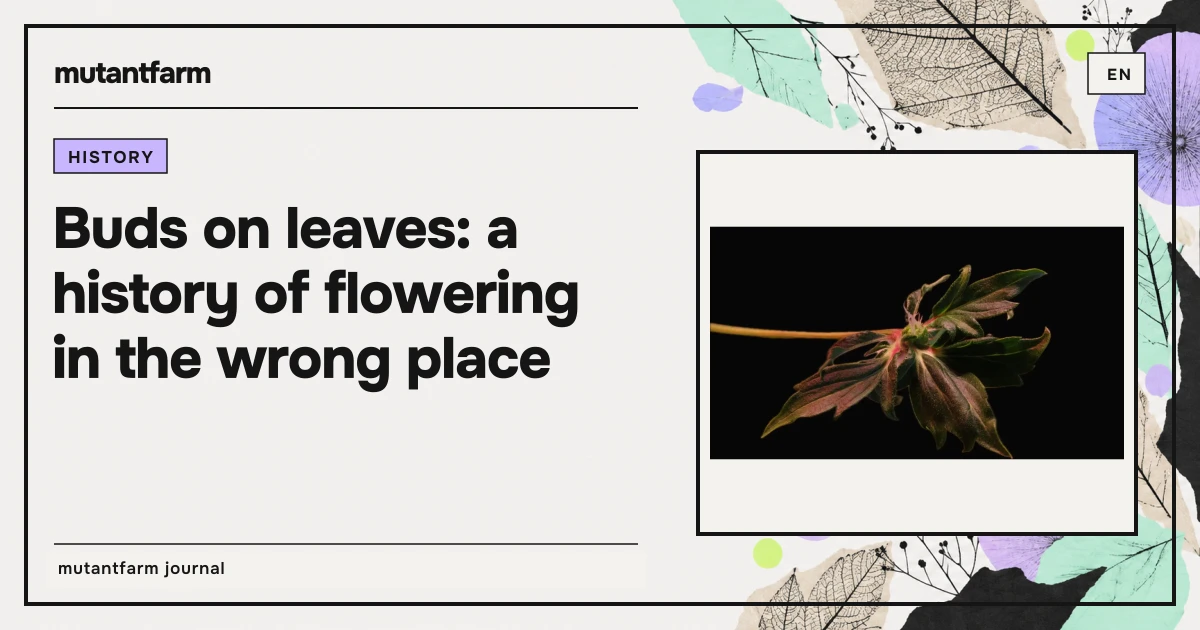
Hey, bro! An ordinary cannabis leaf: a stalk, fingers spreading outward, a serrated edge. And right on that leaf sits a tiny bud. The first thought is that a branch is hiding behind the leaf, but the bud grows on the leaf itself. The flowers have appeared where they normally don’t grow.
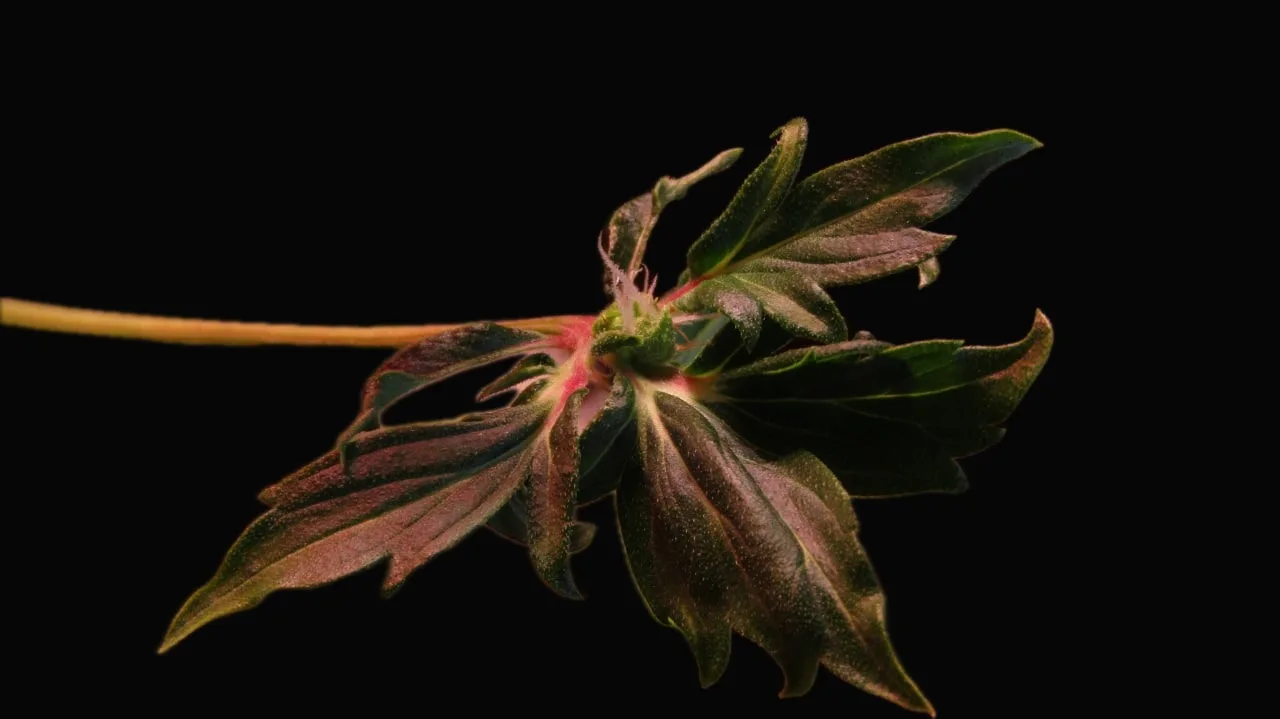
In English-language discussions, these finds are called leaf buds, buds on leaves, and sometimes piggyback. Russian has settled on the equally straightforward “buds on leaves.” It is a colloquial term.
This trait has no single cultivar, founder, or line of inheritance. There are descriptions published long before social media, observations on different plants, and a botanical question: how did a flowering shoot end up connected to a leaf?
How an ordinary node is built
A cannabis bud is an inflorescence: many small flowers, bracts, and greatly shortened side branches. So “a bud grew on the leaf” can mean either a small group of flowers or a more complex structure.
An ordinary large leaf is attached to the stem by its petiole. In the leaf axil, at its base, a side shoot develops, with the node’s other structures nearby. This repeating organization was examined in detail in a 2019 study of the architecture of female Cannabis sativa plants. Spitzer-Rimon and colleagues
On a mutant, the flowers sit farther from the node: on the petiole, or where it turns into the spreading leaflets. In a photo, it looks like a small top right on the leaf.
A bud that a leaf simply covers does not count as a leaf bud. Small leaves inside an ordinary inflorescence are a different phenomenon, too. Similar photos can show different structures.
Robert Clarke, 1981
One of the early written descriptions appears in Robert Connell Clarke’s book Marijuana Botany, published in 1981. The date of the first edition is confirmed by the Toronto Botanical Garden library catalog. Bibliographic record
In the section on leaf traits, Clarke describes a Colombian The first generation from a cross between two parents. F1 ↗ plant. Two of its leaves developed small groups of female flowers on the upper side, where the petiole joins the leaflets. One group contained a partially formed male flower. The author then gives a separate example from Afghanistan: small groups of flowers on the petioles of large leaves. Clarke calls the heritability of this deviation unknown. Marijuana Botany, chapter 3, Leaf Traits
Clarke has two different origins, Colombian and Afghan, and flowers in several positions on the leaf.
Clarke described the cases known to him, and 1981 is the publication date of that description. The observations themselves came earlier.
Epiphylly
Botanists call organs on a leaf epiphylly. For flowers, the phrase “epiphyllous flowers” is used: the structure sits on the leaf or is connected to it in a way that is unusual for that plant form.
Such arrangements also occur in other plants. A 1997 paper by Randall Kerstetter and Sarah Hake covers, for example, Tolmiea, with shoots at the junction of petiole and blade, and Kalanchoe, with young plantlets along the leaf margin. The authors distinguish displacement or fusion of an ordinary axillary meristem from the formation of a genuinely adventitious shoot. Shoot Meristem Formation in Vegetative Development
A meristem is a group of cells from which new organs arise. When such a zone ends up in an unusual place, the plant’s usual body plan changes.
In one case, a shoot becomes connected to a leaf through features of their shared development. In another, a new growth zone forms on the leaf. Which of these applies to a particular cannabis plant is shown by studying how its tissues develop.
The KNAT1 gene
In 1996, George Chuck, Cynthia Lincoln, and Sarah Hake published a paper on the KNAT1 gene in Arabidopsis. When it was unusually active, leaves became lobed, and additional meristems formed near the veins. What grew from them depended on the leaf’s position, and floral structures appeared among them. KNAT1 induces lobed leaves with ectopic meristems
The boundary between leaf and shoot is held in place by the plant’s developmental systems. When their work changes, the boundary shifts.
The KNAT1 experiment shows that this kind of rearrangement is possible in plants. It was carried out on Arabidopsis.
A popular explanation for buds on leaves is “too many hormones.” Hormones take part in plant development, but this explanation does not name the cause in a particular specimen.
Rollitup, 2012
On January 16, 2012, the user djrequiem started a Rollitup thread titled Unusual Budsites. He described additional structures on leaves and posted photographs. Later in the same thread, he identified the plant as Blueberry from Dutch Passion. Other participants reported similar finds on plants with different names. Unusual Budsites discussion
This post has a date, the observer’s username, a description, and photographs. The participant named the cultivar himself.
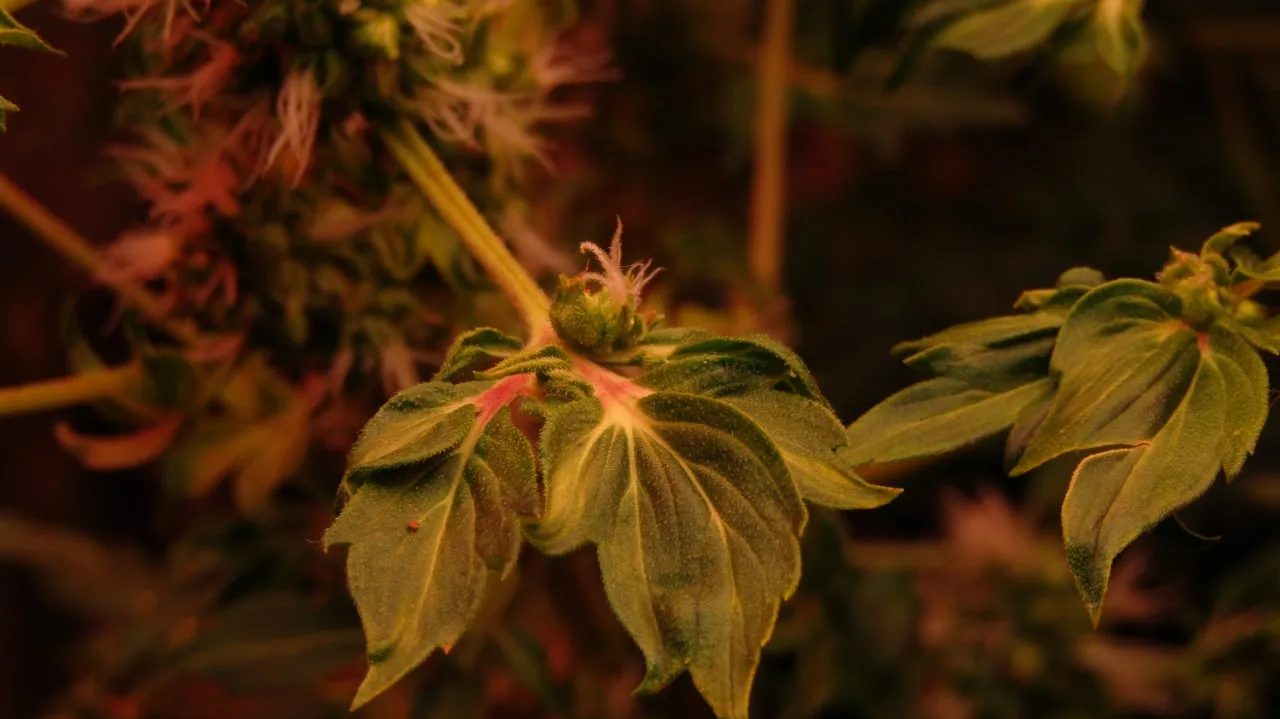
In the same thread, some linked the trait to inheritance, some to conditions, and some remembered similar plants.
A discussion dated May 29, 2022, uses both names: leaf buds and piggy back mutation. Both are colloquial, from growers’ vocabulary. Dated discussion of the terminology
Cannabis chinensis
In the 2012 thread, participants also brought up Cannabis chinensis, as though a bud on a leaf revealed an ancient Chinese type of cannabis. This version later turns up in other discussions as well.
The name Cannabis chinensis exists. The Royal Botanic Gardens, Kew’s Plants of the World Online database dates its publication by Alfred Delile to 1849 and treats it as a synonym of Cannabis sativa. Kew record
A historical account in the US Department of Agriculture’s 1913 yearbook connects these Chinese plants with seeds that reached France in 1846. Hébert, Itier, Delile, and Vilmorin appear in the account, which deals with tall Chinese hemp and its differences from ordinary European forms. USDA Yearbook, Hemp section
This is a history of tall hemp from the nineteenth century. Buds on leaves cannot determine a plant’s country of origin or set it apart as a separate species.
The name itself is real. Forum participants are the ones who linked it to buds on leaves.
Drunken Bastard F3 #16
The photographs in this section show Drunken Bastard F3 #16 with floral structures on its leaves. This plant comes from the mutant.farm archive.
The trait was known long before this line: Clarke described it in 1981. Similar structures also occur on plants with ordinary palmate leaves, so on their own they do not point to kinship with ABC.
Leaf shape, the position of an additional inflorescence, and the sex of individual flowers are three separate traits, even when they occur on the same plant.
On Clarke’s Colombian plant, the partially formed male flower was in only one group, and the other flowers were female.
Who added what
Clarke collected and described examples. Botanists studied how meristems appear outside their usual position. Forum participants preserved photographs. Breeders’ archives added new specimens with their own internal designations.
Each source answers its own question: who recorded the trait, on which plant, what it looked like, and what is known about the mechanism.
The trait was described in print no later than 1981.
Common questions
Is this a new species of cannabis?
No. The position of flowers does not determine a species. Cannabis chinensis is an old name that Kew treats as a synonym of Cannabis sativa.
Can this be called epiphylly?
Yes, if the structure really is connected to the leaf. The term is descriptive: it does not say whether a shoot was displaced, tissues fused, or a new meristem formed.
Is it one known gene?
A known example is the KNAT1 gene in Arabidopsis. No such gene has been named for cannabis.
Is the trait passed on to offspring?
In 1981, Clarke left the question of heritability open. Different cases can have a different nature, as Tolmiea, Kalanchoe, and KNAT1 show.
The bottom line
The history of buds on leaves comes from several sources: Clarke’s 1981 record, studies of plant development, forum discussions, and documented plants from the mutant.farm archive.
The Chinese-ancestor version from the 2012 thread rests on a real name, but the history of that name is tied to tall nineteenth-century hemp.