
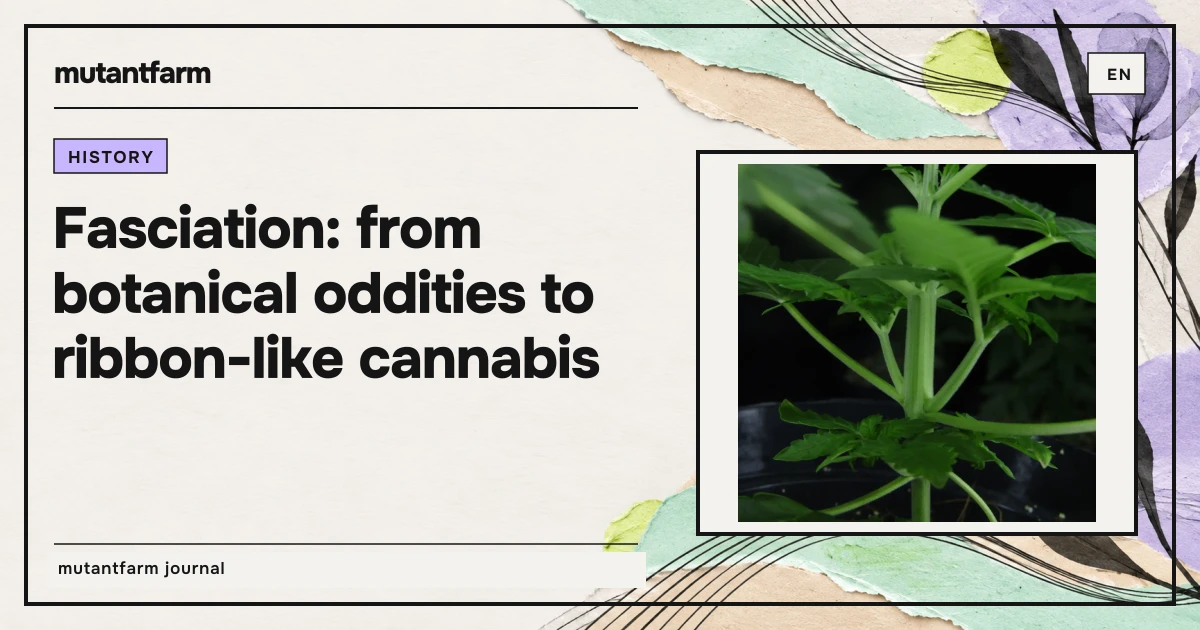
Hey, bro! Some mutants have ordinary leaves, but the stem widens and becomes flat. A broad crest forms at the top, and the inflorescence stretches into a ribbon.
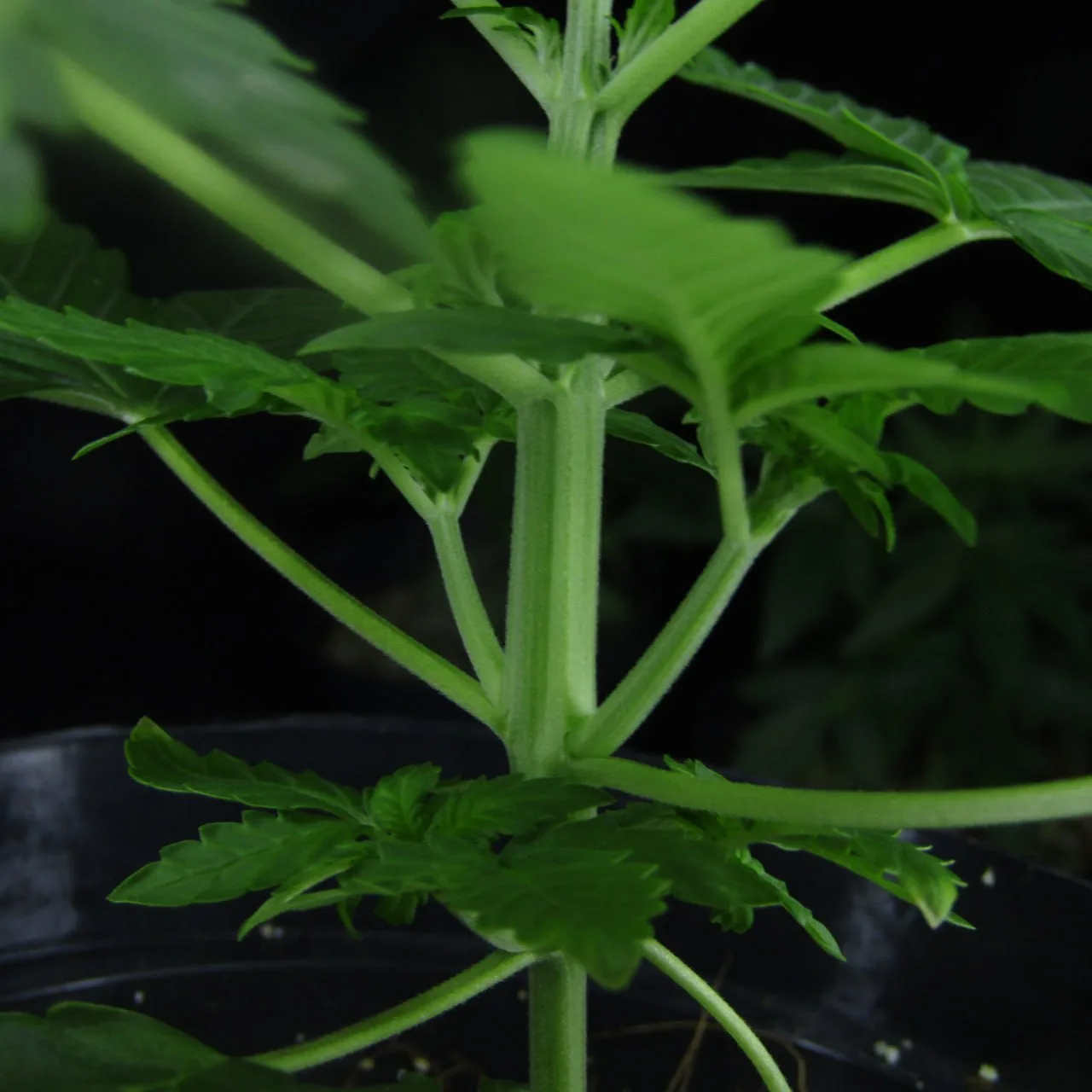
This is one form of fasciation. In the cannabis community, it is often called a “polyploid,” although a flat stem cannot tell you the chromosome number. The opposite happens too: any unusual branching gets filed under one and the same mutation.
Fasciation has a long botanical history, and cannabis entered it long before today’s mutant collections. This history has specific authors and dates.
What happens at the tip
The growing tip of a shoot carries the apical meristem, a small region of cells from which new parts of the plant form. Its size and organization influence how future organs will be arranged.
In ribbon-like fasciation, the geometry of this region changes: an expanded growth zone appears in place of a compact tip. The stem may become broad and flattened, bend, twist, or divide into several extensions. The word “fasciation” describes the resulting structure.
Materials from Oregon’s university plant clinic show ribbon-like and fan-shaped forms. They also list several possible causes of disruption to the terminal bud: damage, mutations, inherited characteristics, and infections. Pacific Northwest Plant Disease Management Handbook
Fasciation is the name of a growth form. The same form comes from different biological causes.
An oddity from the seventeenth century
In 1665, Johann Daniel Major published De planta monstrosa Gottorpiensi, a work about an unusual plant from Gottorp. Maxwell Masters later referred to it when discussing the fasciated stem of a plant called Chrysanthemum. A digitized title page of Major’s publication survives. Title page from 1665, Masters on early descriptions
Molecular genetics was still centuries away. An unusual form was explained by what the eye could see: fused shoots, a change in the direction of growth, the appearance of extra parts.
The “monster” in the title is a plant with an unusual structure. Such plants were described separately because they did not fit the simple picture of how a normal shoot is built.
This is a history of general botany, and there is no cannabis in Major’s work. It shows that such deviations were already being described in the seventeenth century.
Masters, 1869
In 1869, the British botanist Maxwell Tylden Masters published Vegetable Teratology. Plant teratology studies deviations from normal structure: fusions, changes in the number and position of organs, unusual flowers and shoots.
In the fasciation section, Masters described ribbon-like stem expansion, longitudinal ridges, bending, and division of the tip. The illustrations included lettuce, asparagus, pine, and dandelion. He also compared older explanations: whether several parts merge or a single shoot flattens. Vegetable Teratology, Fasciation section
Masters was already separating the visible result from the process that led to it.
He also discussed cases in which the trait recurred in offspring, for example in Celosia. Fasciation can be hereditary, but not always.
Crescini, 1934
In 1934, Francesco Crescini published the paper Sulla fasciazione della canapa (Cannabis sativa L.), “On the fasciation of hemp.” It occupies pages 387–389 of a botanical journal.
Major and Masters wrote about general botany. Crescini’s paper is a separate scientific work on fasciation specifically in cannabis.
The trait in cannabis was described in the scientific literature long before today’s interest in mutants.
Crescini’s paper was included in the bibliography of Orland White’s extensive 1948 review. White, Fasciation, reference to Crescini’s paper
White’s review and the genes
In June 1948, Orland F. White published the review Fasciation in Botanical Review. The forty-page work brought together a substantial body of earlier publications. By mid-century, fasciation was a broad subject in botany. Bibliographic record of the review
Later, researchers moved from describing shape to individual genes. In 1993, Steven Clark, Mark Running, and Elliot Meyerowitz studied CLAVATA1 in Arabidopsis. The mutant plants had enlarged meristems, and strong forms of the alteration produced fasciation. CLAVATA1, a regulator of meristem and flower development
In 2001, Fumio Taguchi-Shiobara and colleagues described fasciated ear2 in maize. Disruption of this gene’s function was accompanied by excessive growth of the ear meristem. Study of fasciated ear2
This gave fasciation molecular explanations. Different plants were used to study different parts of the system that controls growth: CLAVATA1 was described in Arabidopsis, fasciated ear2 in maize.
Fasciation and polyploidy
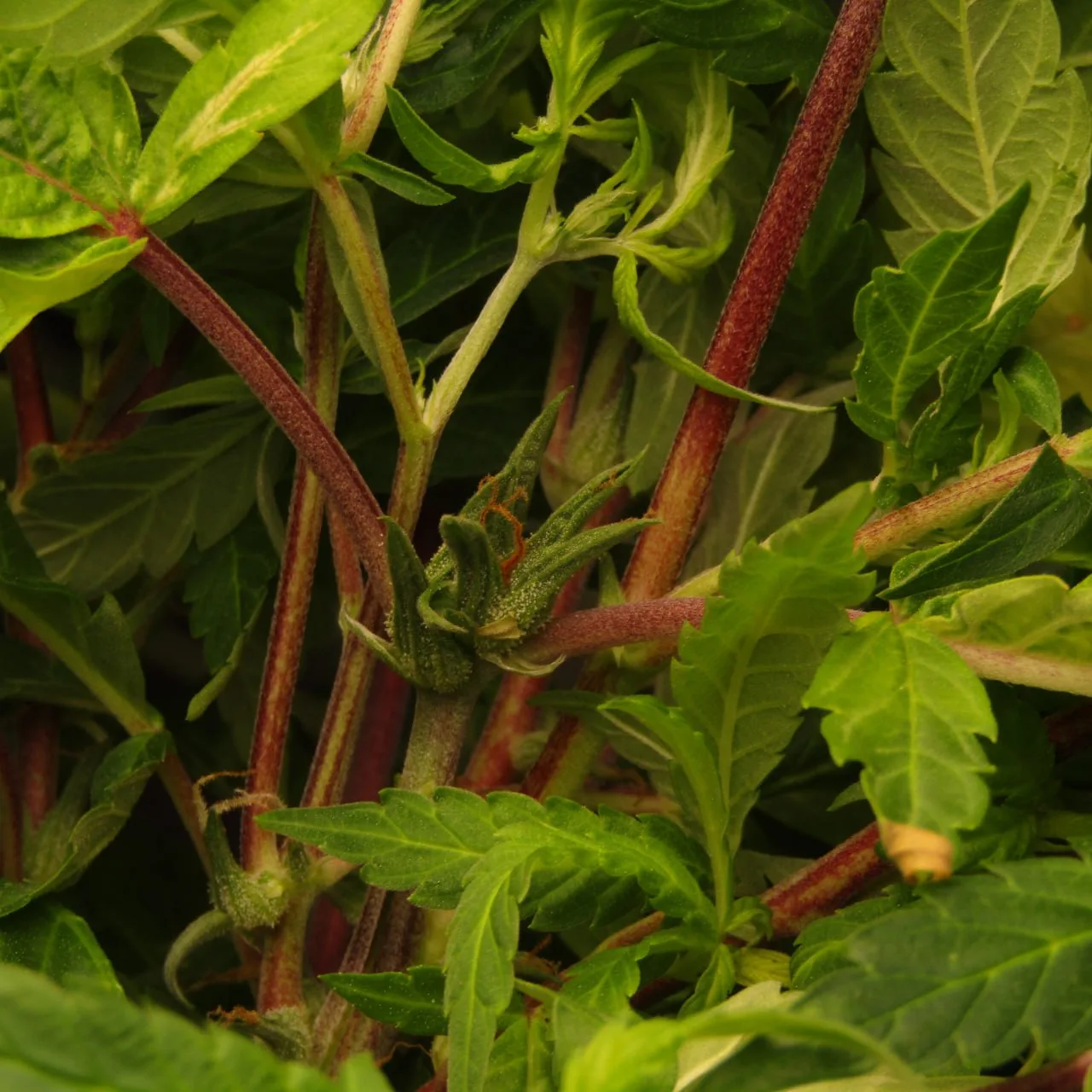
A flat, thick stem is often called polyploid: the plant looks as though it has been given “more of everything.”
Polyploidy is an increase in the number of complete sets of chromosomes. Fasciation is a change in the organization of growth. One word refers to the chromosome set, the other to form and development.
Cannabis in its ordinary diploid state has 20 chromosomes. A different set is established by cytological or genomic analysis. Biology of Cannabis sativa, CFIA
Different deviations can occur on the same plant. But a broad bud, a three-leaf arrangement, or a split tip does not on its own show a doubled genome: known mechanisms of fasciation work through the meristem.
In forum language, “polyploid” is a name for how a plant looks.
Fasciation from infections
A report by Hannah Rivedal’s group on Spiroplasma citri in field-grown hemp in the northwestern United States appeared online in 2023 and in a journal issue in 2024. Oregon surveys in 2021–2022 recorded leaf deformation, chlorotic mosaic, and fasciation among the symptoms. First report of Spiroplasma citri
In 2026, Camille Wagstaff and coauthors reported detecting “Candidatus Phytoplasma trifolii” and Spiroplasma citri in Washington State hemp. Material was collected in 2022 and 2024, and stem fasciation was again among the reported signs. The researchers noted that mixed infections make it harder to link a symptom to a particular pathogen. Report from USDA ARS and Washington State University
A flattened tip can also be a symptom of disease.
In these studies, pathogens were confirmed in the lab from samples. A photograph shows the form, but it cannot determine the cause.
The mutant.farm archive
The mutant.farm archive contains a photograph of fasciation in Lowryder. Other growth deviations are preserved there too, including an entry dated April 6, 2023, about Freak Ryder The first generation from a cross between two parents. F1 ↗: a cluster of floral structures appeared at the tip of one shoot instead of continued growth.
A shoot ending in a flower, a broad crest, and ordinary branching are different events. Fasciation is identified by widening and flattening of the axis or the tip.
Ordinary cannabis also shows different ways of ending an inflorescence: the apical meristem either keeps developing or ends in a flower. A stopped tip is not fasciation in itself. Study of cannabis architecture, 2019
Lowryder with fasciation and Freak Ryder F1 with a cluster of flowers at the tip are two different growth deviations.
Common questions
Who bred fasciation in cannabis?
The phenomenon has no single author. There are authors of publications and people who noticed particular plants. An early scientific paper on fasciation in cannabis is Crescini’s 1934 article.
Is fasciation always genetic?
No. Genetic mechanisms are known, but damage and infections produce the same form.
Does a flat stem mean polyploidy?
No. Chromosome number and meristem organization are different characteristics. Polyploidy is determined from data on the chromosome set.
If one branch is altered, is it a separate cultivar?
No. An altered branch is an observation on one plant. A line appears when the trait recurs in offspring, as with Celosia in Masters’s descriptions.
Do all photos of unusual buds show fasciation?
No. Fasciation is identified by the structure of the shoot and the tip. A dense bud, an unusual outline, or stopped growth is not fasciation.
The bottom line
The history of fasciation is Major’s 1665 work, Masters’s 1869 book, Crescini’s 1934 paper on hemp, and studies of meristems. Data on pathogens and amateur photographs came later.
The question has changed over time: first unusual plants were described as oddities, then their structure was studied, and now the cause of the form is investigated.
Botanists have their own name for a flat stem: fasciation.