
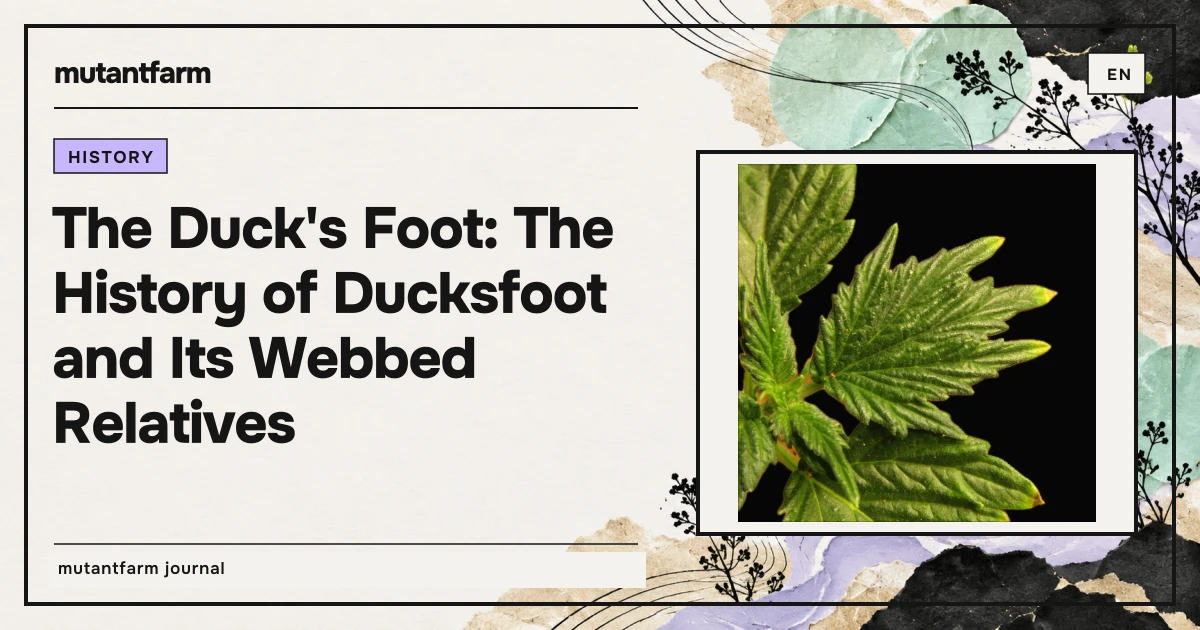
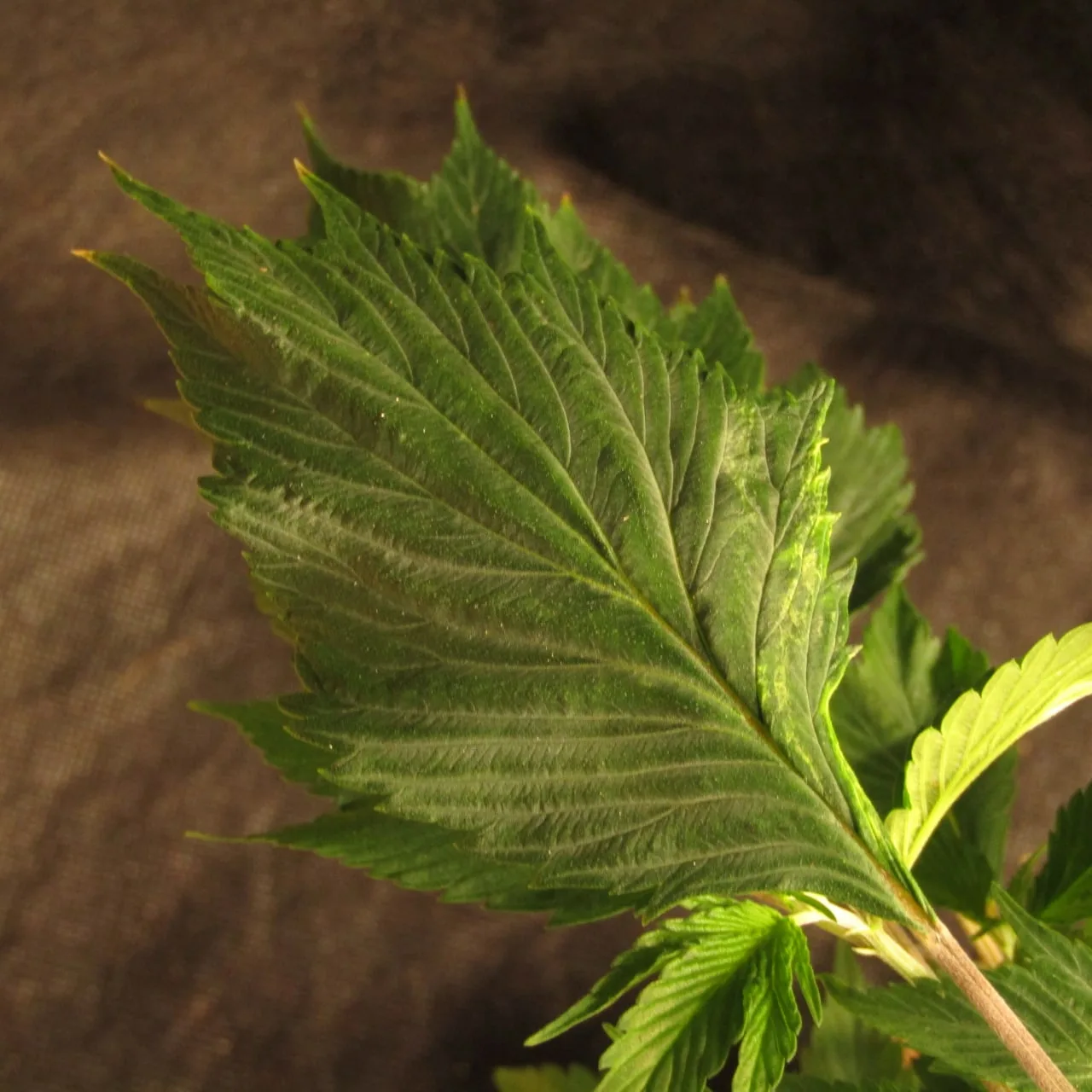
Look at a Ducksfoot leaf. The familiar cannabis “fingers” are still there, but the gaps between them are filled with tissue. The result is a broad, lobed blade that looks like a duck’s foot.
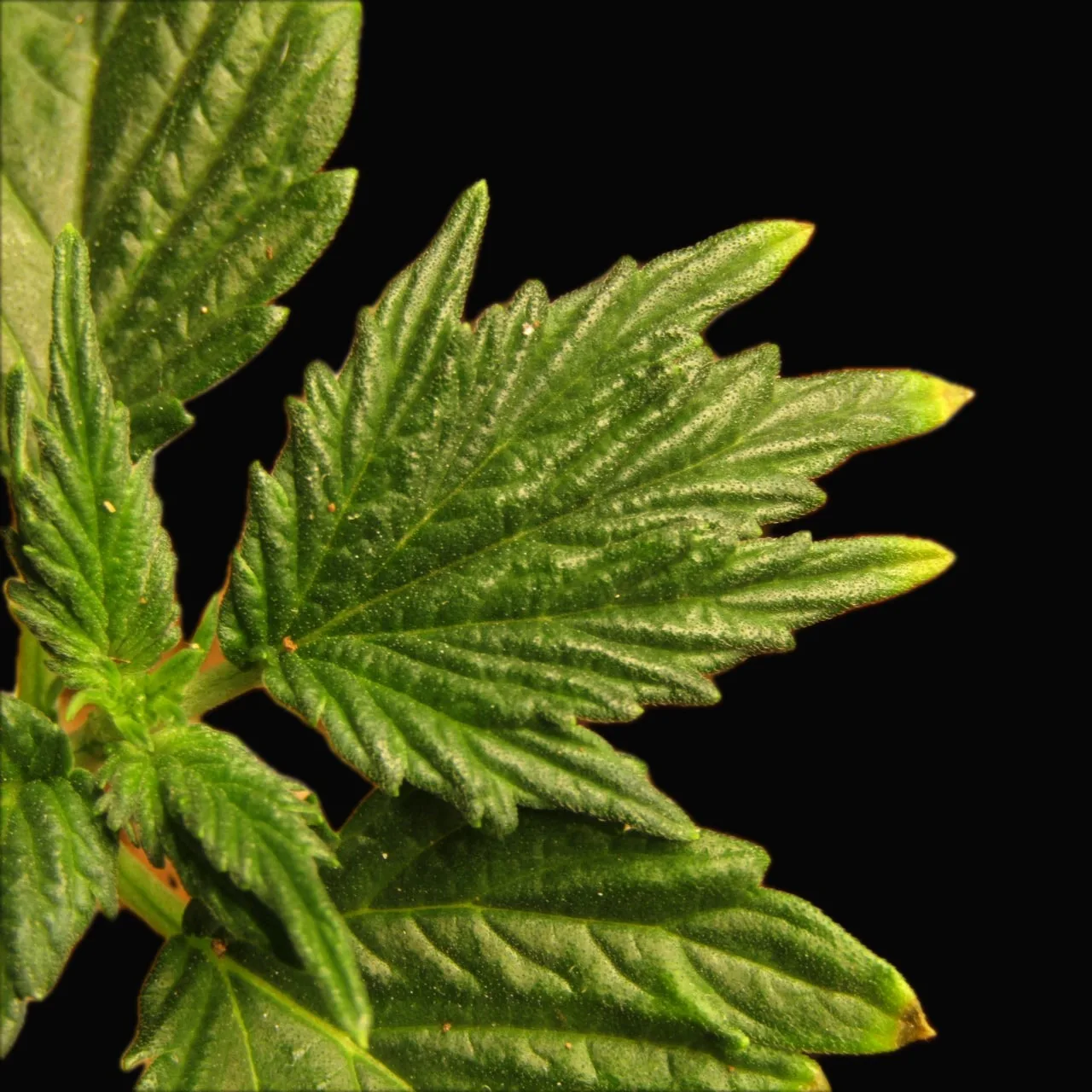
Many names are tied to this form: the Australian Wally Duck, Hawaiian Webbed Indica, Strawberry Web, Frisian Duck, Auto Duck. The oldest description of such a leaf was left by American industrial hemp researchers in the early twentieth century. Different people found a similar leaf at different times and called it by different names.
The 1922 description
In June 1922, Walter Scott Malloch of the University of Illinois published a paper in the Journal of Heredity on how well hemp suits the study of sex inheritance. Among his plants was an unusual Ferramington specimen. It had been sent by L. H. Dewey of the United States Department of Agriculture and Professor A. H. Wright of the University of Wisconsin.
Malloch described a leaf whose separate leaflets looked as though they had fused. Several main veins and their lobes remained, while the tissue between the veins developed unevenly and the surface of the leaf was pleated. The form is shown in figure 20, and the description is on pages 282–283. Walter Scott Malloch, 1922
From the description, this is very close to what is now called a webbed leaf. Wally Duck, Hawaii and the Ducksfoot cultivar are not mentioned in the paper: Malloch was working with his own Ferramington material and studying sex inheritance.
The webbed leaf appeared in a scientific journal almost a hundred years before today’s lines, long before internet forums and mutant catalogs.
Malloch recorded only what he saw: the leaflets looked “as though fused.” The paper says nothing about genes or the mechanism of leaf development. It is a description of form, and it can be compared with later plants.
Wally Duck
The central figure of the modern story is Wally Duck. On ICMag, he posted under the older display name guest123 and as Donald Mallard. In a recollection dated February 6, 2021, he said he had found this kind of material around the very beginning of 2000. He did not claim the mutation as his own: he worked with a form that had already been found and preserved it in his line.
In the same thread, he mentioned earlier accounts of webbed plants in Hawaii and Australia and allowed that his material might have Hawaiian roots. Wally noticed an unusual form, took it up and made it known far beyond his own circle. Donald Mallard’s recollection, February 6, 2021
In September 2024, Wally added a detail about the name. He had received the material from someone who lived nearby, and the mix included plants with different leaves. That person was already using the word Ducksfoot. Wally did not know where that person got the name. So, by Wally’s own account, the name was in use before him. Wally Duck on Overgrow, post 653
For the Ducksfoot line, Wally is the key person. The webbed leaf itself had been seen before him, and Wally is one of the people who noticed it and kept it.
Ducksfoot in 2004
On May 4, 2004, Wally replied on ICMag to someone asking whether he was the person behind Ducksfoot. He said he was, and pointed the reader to his article in International Cannagraphic magazine and to the Ducksfoot entry in the old Overgrow Strain Guide.
On May 7 in the same thread, Wally was already separating his own Ducksfoot from a hybrid with webbed indica. So by spring 2004 the line was known, its history had been written up in a magazine and on forums, and work with other webbed material was already underway. Wallyduck?? thread, May 2004
The second volume of The Big Book of Buds, published in 2004, also included Ducksfoot and credited Wally Duck. The book fixed the line’s look: characteristic bridges between the leaf lobes, which can become more or less pronounced as the plant develops. Ed Rosenthal, The Big Book of Buds, volume 2
About four years passed between Wally’s find and the book.
Hawaii
Jason King’s The Cannabible, published in 2001, has a short entry on Strawberry Web. King calls it an old Hawaiian line and explicitly mentions its webbed leaves. This is an early printed mention of both the name and the trait. Jason King, The Cannabible, Strawberry Web
In February 2024, ICMag member Lolo94 recalled hearing the names Web and Strawberry Web on the Big Island as early as 1994. He also remembered a plant that an acquaintance called Duckfoot. By his own account, 1994 is the year he himself learned of these lines. Lolo94, February 17, 2024
According to these accounts, webbed plants were in Hawaii before Wally found his material at the beginning of 2000.
In a 2010 discussion, ClearBarbedFunk was already distinguishing Strawberry Web, webbed indica and material called Webbies, associated with wesos. At the time, Hawaiian names were used for several different materials. Discussion of Hawaiian lines, February 2010
Relatives and namesakes
Wally said that in the early 2000s he got Hawaiian Web, or Webbed Indica, from seakay2 in an exchange. By his account, this material differed noticeably from his more sativa-like Ducksfoot: the leaf was shared, but the plants were different. He considered them two separate starting materials and went on to work with both. Wally’s account of the exchange
Today, the name Duckweb in collections and catalogs refers to a particular creator’s line.
There are also stories of a Hawaiian line supposedly kept unchanged since the 1950s. In September 2024, the origins of Duckweb were discussed on Overgrow: participants offered different versions, corrected their own assumptions, and could not trace every connection. Duckweb discussion, September 2024
Kinship between lines is shown by records of seed transfers and by genetics. A photograph of a leaf shows only its shape.
Underground Seeds Collective
Wally’s Ducksfoot was kept by Underground Seeds Collective (USC). On February 20, 2013, their Ducksfoot F3 was discussed on ICMag. The opening post quoted the creator’s notes on a third generation from the summer of 2011. Underground Seeds Ducksfoot, 2013
On April 27, 2014, USC representative jahgreenlabel posted on CannaWeed. He named Wally as the creator of the original line, said the collective had continued working with it, and described their material as the fourth generation. jahgreenlabel, CannaWeed, April 27, 2014
In March 2020, Cristalin on Overgrow called the USC version original fifth. The generation numbers here are counted within the USC collection. Cristalin, March 4, 2020
This happens with many preserved lines: over time, the new keeper’s name, and sometimes a generation number, is added to the original name. At USC, Wally’s name stayed.
Hybrids before Frisian Duck
In February 2008, an ICMag report appeared on Ducksfoot × Afghan from Dr. D. The recipient wrote that he had obtained the material at a gathering the previous year, and showed plants with varying degrees of webbing. Wally joined the discussion.
So by 2008 Ducksfoot already had a hybrid branch. In it, descendants of the same ancestor came out with different leaves. Ducksfoot × Afghan, February 2008
On June 17, 2015, ICMag member canned abyss1 wrote that he had created Spyderweb from his own Spyder line and Ducksfoot. He described it as an A plant that starts flowering independently of the length of the day. autoflowering ↗ form with webbed leaves. By that date, he already had the line. canned abyss1 on Spyderweb, 2015
Spyderweb appeared before Dutch Passion announced Auto Duck for 2017. Different people came to the idea of an autoflowering duck independently, in different communities.
Frisian Duck and Auto Duck
Frisian Duck from Dutch Passion showed the webbed leaf to a new audience. On March 4, 2015, Tony Passion presented it in THCENE as a new release for the season. Its listed parents are Frisian Dew and Ducksfoot. Tony Passion, Frisian Duck, March 2015
In its own account, Dutch Passion writes that it selected Ducksfoot from a collection and worked with it for several years. The company does not name the donor or the route the material took. Dutch Passion’s account of Frisian Duck’s origins
The company announced Auto Duck for 2017, linking it to Frisian Duck and Auto White Widow genetics. Its leaf type is the same. Dutch Passion’s announcement for 2017
Dutch Passion gave the webbed leaf a prominent place in its range and showed it to a broad audience.
The 2020s: Moon Duck, Duckweb, Double Duck
By the 2020s, there were many names with Duck and Web. In a September 2022 announcement, Double Duck from Annunaki Genetics was described through Moon Duck F4 and Duckweb Inbred Line: a line selected over generations to reproduce particular traits consistently. IBL ↗. In the same announcement, Purple Smooth Leaf was linked to a different combination that included Frisian Duck, but its main feature was already a smooth leaf edge. Annunaki Genetics announcement, September 26, 2022
The names mean different things. One points to an original line, another to a particular hybrid, a third to a striking leaf detail.
That is why Moon Duck, Duckweb, Double Duck and Frisian Duck are separate lines, even though their leaves look alike. The word Duck in a new name does not prove ancestry.
The line and the trait
The word Ducksfoot is used both for Wally’s line and for the webbed leaf itself. In botany, these are two different concepts.
The tissue between the lobes, the number of lobes, the teeth and the width of the blade vary. The leaves of a single plant also change as it develops. Manica Balant and colleagues showed this in 2024 using 341 leaves from 24 plants belonging to nine Cannabis accessions: leaf shape tells you both where an accession comes from and its stage of development. The study shows why one random leaf cannot describe a plant. It did not look for a Ducksfoot gene. Balant and colleagues, New Phytologist, 2024
The same applies to inheritance. Whether Ferramington from 1922, Hawaiian Webbed Indica and Wally’s Ducksfoot carry the same mutation cannot be told from forum photographs.
Timeline
In 1922, Malloch describes an unusual fused leaf. In 2001, Strawberry Web is already in print. In the early 2000s, Wally works with his Australian line and exchanges material with Hawaiian keepers. By 2004, his Ducksfoot is discussed in magazines and on forums. Then come hybrids, preservation by USC, Frisian Duck, Auto Duck and new branches.
The webbed leaf has several histories: the scientific one from 1922, the Hawaiian one and the Australian one. They overlap, sometimes contradict each other, and do not fit into one tidy tree.
Wally Duck is the central figure in the history of the Australian Ducksfoot line. Besides him, the webbed leaf was kept by Hawaiian keepers, USC and the makers of small hybrids.